

Here’s the truth: the question What Makes Someone Jamaican? has become one of the most emotional, divisive, and surprisingly universal debates online. And it’s not just Jamaica. Every diaspora community feels this tension. But when Jamaicans talk about identity, something deeper rises to the surface: history, pride, belonging, and the meaning of home.
And that’s exactly why this argument touches a nerve every time it appears.
The Question That Lights Up the Internet
It often starts with a simple comment:
“You’re not Jamaican. You weren’t born here.”
Nine words. One cultural earthquake.
Anyone with Jamaican heritage who grew up abroad knows this moment. Their patois is questioned. Their cultural claim is challenged. Their connection is doubted. For some, it feels like being told they don’t have the right to their own story.
And that’s why the statement hits so hard. Because identity is not static. It is lived, learned, inherited, and carried.
Does Speaking Patois Authentically Make You Jamaican?
Recently, Jabari Brown, better known as Treezy2x, the young Jamaican who won the Jet in the Mr. Beast challenge, found himself at the center of a familiar identity debate. Someone questioned whether he was “really Jamaican” simply because of how he speaks.
For him, it wasn’t just a random comment.

Not only was it a stereotype that has followed Jamaicans for generations: the idea that Jamaicans cannot be articulate, well-spoken, or educated; it struck at something deeper his identity, his belonging, and his right to claim where he is from.
This was not just about his accent. It was about protecting the dignity of an entire culture.
And he wasn’t only fighting a stereotype.
He was fighting an accusation that tried to erase who he is, to strip him of his nationality, his roots, and his right to claim Jamaica.“First of all, mi jus waa yuh kno seh, mi baan an raise ah Jamaica, baan an grow up ah St. Catherine, still av house inna St. Catherine.”
From the beginning, he rooted his defense in birthplace, home, and lived experience — the core elements of his identity.
Then he addressed the insult embedded in the accusation, the idea that speaking well somehow cancels Jamaican identity:
“Numbah two, mi tek offense tuh dat, an evry Jamaican should tek offense tuh dat, becuz basically yuh a seh Jamaicans aren’t articulate.”
Then he challenged the claim that speaking properly somehow disqualifies him from being Jamaican. Jabari explained that code switching, the ability to move between standard English and a dialect in this case: Jamaican Patois, is a normal, powerful part of Jamaican culture:
“Because me speak properly and me can switch it on and off, that means me not Jamaican? So just every Jamaican just dunce out?”
To reinforce that identity is lived, not performed, he listed the ties that shape who he is:
His mother worked at Spanish Town Hospital.

Jabari Brown Mom
His father drove for JUTC.

Jabari Brown Dad
He travels to Jamaica often.
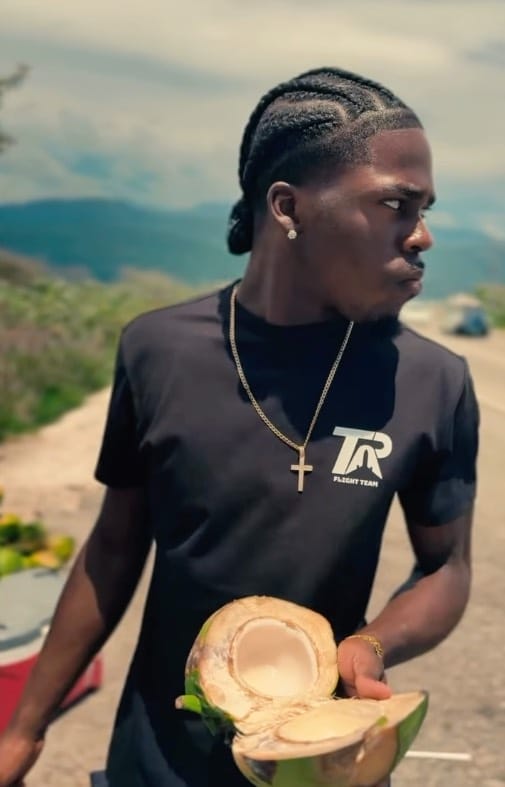
Jabari Brown in Jamaica
He holds Jamaican passports.

Jabari Brown old Jamaican passport
His community raised him.
Then he delivered the line that captured the heart of the conversation:
“I know seh Jamaica produce wol heap ah intellectual, smart people. Suh dat statement dere weh yuh meh, not ready.”
Within minutes, the comments section became a cultural town hall:
Gramps Morgan:
“Can you imagine because you speak proper??? Mi Mumma”
Toyaa:
“We CODE SWITCH. We do speak ‘PROPER ENGLISH’ .. However; we are also able to tell you ‘bout yuh MUMMA in several different dialects!”
Sweetlike_that:
“I do take it as a disrespect, and it’s annoying when someone says to me why don’t you speak Jamaican? Like wa yu waa mi fi say? GSYM does that work for you?”
Dre_Giftcenter:
“The person who made that comment has never seen a travel visa in his life”
Gorgeous_Martina:
“WE THE PPL OF JAMAICA LOVE YOU AND WE ARE SUPER PROUD OF YOU”
The collective message was clear:
Speaking properly does not make someone less Jamaican. Ignorance does.
Why Some People Say You Must Be Born in Jamaica
This perspective shows up often in heated comment threads:
Birthplace equals authenticity.
Birthplace equals lived experience.
Birthplace equals “real Jamaican.”
For many island-born Jamaicans, culture isn’t just food, music, or slang. It is daily life:
Power cuts. Taxi culture. School days. Cold-stove mornings. Rum-bar politics.
The things you cannot learn from a yearly visit or a YouTube clip.
To them, identity without lived reality feels incomplete.
And beneath the frustration is a quiet fear: cultural dilution.
The Diaspora: “Birthplace Doesn’t Own My Identity”
But here’s the twist: many who were not born in Jamaica feel just as Jamaican — sometimes more.
They grew up with Jamaican parents.
They were raised in Jamaican households abroad.
They know the food, the music, the proverbs, the values.
Their identity wasn’t a hobby — it was a home inside their home.
And for many of them, they feel like outsiders within the borders in which they reside. They are constantly asked about their ethnicity and labelled as such. They resonate more with the Jamaican culture than the culture of the land they live in.
This side argues that the argument Jamaicans are born in Jamaica is a limited thought process because:
1) Heritage matters.
2) Culture travels.
3) Identity is inherited.
4) Blood remembers.
In this view, Jamaica isn’t just geography — it’s lineage, legacy, and love.
The Unspoken Layer: History
Here’s where the conversation gets real.
Jamaicans are a people formed through displacement: colonization, slavery, and migration.
Families were torn apart. Names were changed. Roots were disrupted.
Identity had to be rebuilt from fragments, memory, resistance, and pride.
Movement is part of Jamaica’s DNA.
From the forced crossings of the Middle Passage to the mass migrations of the 1950s and 60s when Jamaicans travelled to Britain and North America in search of opportunity, Jamaicans have always carried their homeland with them.
Even when they left the island, the island never left them.
And so is reclaiming identity across oceans.
Every Jamaican household abroad, from Toronto to London to Brooklyn, becomes a small island of its own: the accent, the food, the music, the stories, the proverbs, the discipline, the love.
Culture becomes something both inherited and protected, a way of staying connected to a home you may not have been born in but were undoubtedly shaped by.
Jamaicans abroad didn’t choose to dilute their identity.
They chose to preserve it: against assimilation, against invisibility, against the fear of losing who they are.
That is why telling someone they aren’t Jamaican because they were not born there does not feel like a casual correction.
It feels like repeating an older harm, a historical erasure.
It echoes the periods when Jamaicans were told they did not belong anywhere.
When identity was taken from them.
When their right to claim a place, a people, or a culture was denied.
So when this debate resurfaces today, it carries centuries of emotional weight.
It’s not simply about where your birth certificate was issued.
It’s about belonging, legacy, survival, and the ongoing fight to hold on to a cultural identity that has already lived through so much displacement.
And that is why the question, What Makes Someone Jamaican? goes far beyond “Where were you born?”
It becomes a question about history, memory, and the many ways Jamaicans continue to create home, wherever in the world they stand.
So Who Gets to Decide?
There is no single Jamaican identity.
No single Jamaican experience.
No single Jamaican definition.
Legally: One Jamaican parent qualifies.
Culturally: Communities shape belonging.
Emotionally: Identity is personal.
Socially: Everyone draws their line somewhere different.
That is why the debate never dies; it lives in the crossroads of law, memory, culture, and belonging.
The Real Reason This Question Touches a Nerve
Because this is not only about Jamaica.
It is about every immigrant child.
Every person with two homes.
Every family that crossed oceans but kept their roots.
Every culture that survives outside its borders.
It is a universal struggle wrapped in Caribbean language.
The Takeaway: Jamaica Exists Wherever Its People Are
Whether you were born in Kingston, St. Catherine, Toronto, London, Clarendon, or New York, identity does not shrink to a map.
Jamaica exists in:
The stories your grandparents told.
The seasoning in your kitchen.
The music that shaped you.
The way you talk, laugh, argue, and love.
The pride you feel when reggae plays or when Jamaican excellence hits the world stage.
If Jamaica shaped you, even from afar, then you carry the island in ways no document can measure.
And maybe that is the real answer to the question:
What Makes Someone Jamaican?


