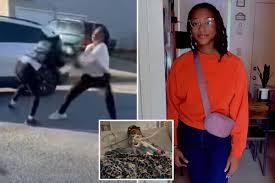

A community is mourning the loss of a seventh-grader whose death is raising urgent questions about bullying, school safety, and why no one stepped in to stop the violence.
A middle school student in Georgia has died after a fight with another student near a school bus stop in Douglas County, about 30 miles west of Atlanta. Jada West was just 12 years old, and her family says she had only recently transferred to Mason Creek Middle School — where she had already been dealing with bullying before the tragic altercation.
The incident occurred on a Friday afternoon after school, when Jada got off the bus near her home. Cellphone video shows a confrontation with another group of kids that quickly turned physical. Jada took a hard fall and began losing consciousness.
Although she was able to get up and walk away after the fight, she had to be rushed to the hospital shortly afterward when her heart stopped. She suffered brain damage and was placed on life support. Her family gathered at her bedside, heartbroken. “You were so young, so loved, and you did not deserve this,” her aunt wrote in a public post.
Jada suffered cardiac failure and died. In the aftermath, her family pointed to something that many witnesses of the fight hadn’t done: “Nobody tried to stop it.”

The Bystander Effect: When Watching Becomes Dangerous
That haunting phrase — nobody tried to stop it — cuts to the heart of a well-documented psychological phenomenon known as the bystander effect. First identified by social psychologists John Darley and Bibb Latané following the 1964 murder of Kitty Genovese in New York, the bystander effect describes the tendency for individuals to be less likely to intervene in an emergency when other people are present.
The reasoning is counterintuitive: the more witnesses there are, the more each person assumes someone else will act. Responsibility becomes diffused across the crowd — and in that diffusion, no one does anything.
In Jada’s case, cellphone video shows multiple bystanders watching and recording the fight. Not one person is seen attempting to intervene, de-escalate, or call for help — at least not until it was too late.
Experts say this is tragically common, especially among adolescents. Research on school bullying consistently shows that the presence of a crowd can actually escalate violence rather than deter it, as onlookers can inadvertently signal to an aggressor that their behavior is acceptable or entertaining.
What Could Have Been Done?
Child safety advocates stress that bystanders — even young ones — have more power than they realize. Intervention doesn’t have to mean physically stepping between two fighters. It can mean:
- Loudly saying, “Stop — this is not okay.”
- Walking away and refusing to provide an audience.
- Immediately calling or running to get an adult.
- Calling 911.
Studies show that in roughly 57% of schoolyard conflicts, peers have the ability to stop a fight within 10 seconds — simply by intervening verbally. The challenge is that most young people freeze, fearing social consequences or assuming someone else will act first.
A Family Demanding Justice
According to Jada’s aunt, the argument between the two girls had begun at school earlier that day and continued on the school bus. The family described Jada as someone who had never been in trouble, saying she was “a good kid” who was simply standing her ground against a bully.
Jada’s family is also questioning why the other girl was allowed on the school bus, believing she did not live in the neighborhood or normally get off at that bus stop.
Villa Rica police and the district attorney’s office are currently reviewing video footage from the fight to determine whether charges may be filed. West’s family has asked that the video not be shared publicly.
The Douglas County School System expressed deep condolences, stating that the well-being of students and staff is a top priority, and that any situation resulting in harm to a child is taken with the utmost seriousness. School officials noted that the incident did not occur on school property or during school hours.
Jada’s mother, Rashunda McClendon, said she should be planning a movie night with her daughter — not a funeral. “It’s gotta stop. It must stop. Violence has to stop,” she said.
What Parents and Schools Can Do
Jada’s death is prompting a broader conversation about what schools, parents, and students can do to break the cycle of bystander inaction:
- Teach intervention skills early. Schools can integrate bystander intervention training into health and social-emotional learning curricula.
- Talk to your kids about what to do when they witness bullying or a fight — and make clear that recording on a phone is not the same as helping.
- Create anonymous reporting systems so students can flag threats without fear of being labeled a “snitch.”
- Address bullying before it escalates. Jada’s family says she had been experiencing bullying since enrolling at Mason Creek. Earlier intervention by school staff may have prevented the confrontation entirely.
If your child is experiencing bullying, contact their school administration and document every incident in writing. In an emergency, always call 911.
Justice for Jada.


