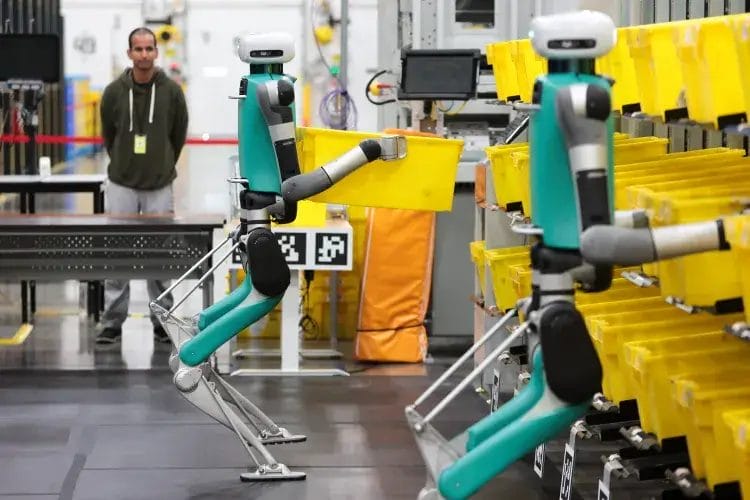

Amazon built its empire on human speed — now it’s betting on robotic precision.
According to leaked internal documents obtained by The Verge, the e-commerce giant is quietly preparing to replace as many as 600,000 U.S. warehouse and fulfillment jobs with automation by 2033.
The revelation has ignited a nationwide conversation: Are we witnessing the future of efficiency — or the end of human labor as we know it?
From Prime Delivery to Prime Automation
Amazon’s warehouses already hum with robotics. Mechanical arms sort packages, driverless carts glide through aisles, and AI systems track inventory in real time.
But this new plan goes further — aiming to automate up to 75% of operations within the decade.
The leaked memo outlines billions in projected savings: lowering costs by “about 30 cents per item” and avoiding up to 160,000 new hires by 2027.
To executives, it’s innovation. To workers, it feels like a warning shot.
What Amazon Says
In response to the reports, Amazon insists that the documents represent “one internal team’s proposal” — not official company policy.
A spokesperson emphasized that Amazon is still hiring thousands of seasonal and full-time employees, arguing that automation is meant to “make work safer and more efficient,” not to eliminate it.
Still, the numbers tell a different story: a gradual “flattening” of the company’s hiring curve, as robots quietly take over tasks once handled by human hands.
The Bigger Picture: A Robot Revolution in Real Time
Amazon isn’t alone. Across industries, automation is reshaping how people work — from self-checkout lanes to AI customer service bots.
But the scale here is staggering.
Amazon employs over one million people in the U.S. alone. A shift of this size could ripple through entire communities, especially towns built around warehouse jobs.
Experts warn that while automation boosts productivity, it also widens the gap between those who design the robots — and those replaced by them.
Opportunity or Obsolescence?
There’s another side to the story.
Some economists argue that automation can create new, higher-skilled jobs — in robot maintenance, data analysis, and logistics design. But those opportunities require retraining, something many workers don’t have easy access to.
As one labor analyst put it, “Amazon isn’t just automating jobs — it’s automating livelihoods.”
What This Means for the Rest of Us
For consumers, it could mean faster shipping and lower costs. For workers, it could mean a future where job security depends on how quickly they can adapt.
The conversation isn’t just about Amazon anymore. It’s about every company that looks at a robot and sees a cheaper, tireless employee.
The Takeaway
Amazon’s leaked plan isn’t just a corporate strategy — it’s a preview of a new era.
An era where the line between human and machine labor blurs faster than policymakers can respond.
Automation isn’t coming. It’s already here.
The question now is whether America is ready for what happens next.


